
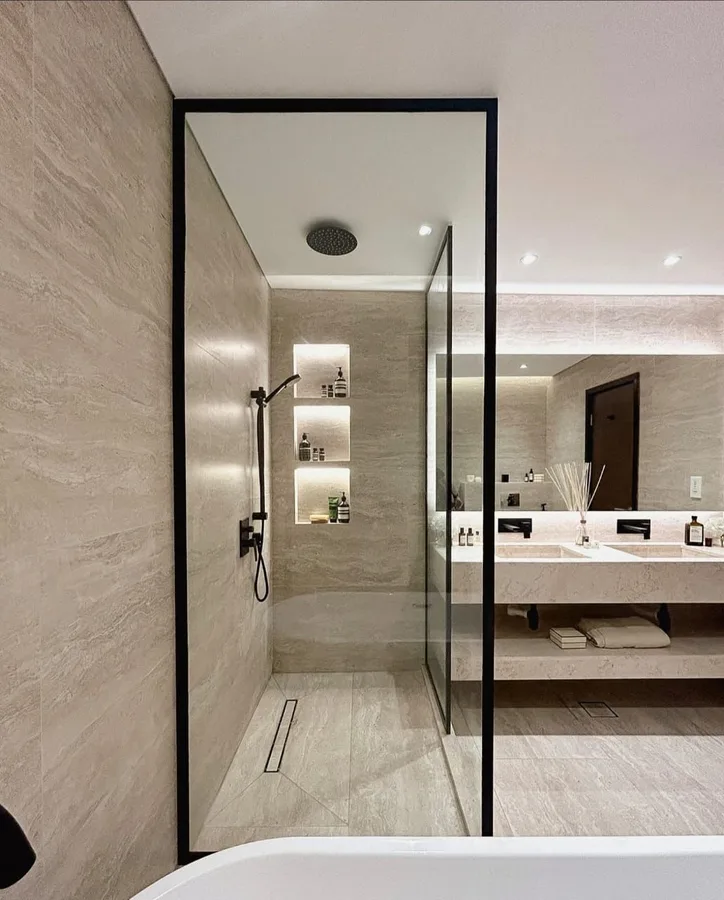
Choosing shower glass in Dubai — the real differences between framed, semi-frameless and frameless screens, what each costs to run, and which suits your bathroom.
The three types, honestly compared
Almost every shower screen quote in Dubai lands in one of three families. The differences are not cosmetic — they change how forgiving the installation is, how the screen behaves over five years, and how much you pay.
| Type | Glass | Tolerance for out-of-square openings | Relative cost |
|---|---|---|---|
| Framed | 6–8mm toughened | High — the frame absorbs the error | Lowest |
| Semi-frameless | 8–10mm toughened | Moderate | Middle |
| Frameless | 10–12mm toughened | Low — demands an accurate opening | Highest |
Framed screens
Aluminium runs along every edge of the glass. That frame is doing real work: it carries the panel, it hides the fact that almost no Dubai shower opening is perfectly square, and it gives the seal something consistent to close against.
Framed screens have an image problem because cheap ones look cheap. But a framed screen in matt black or bronze, with 8mm glass and decent hardware, looks deliberate rather than budget — and it is the most reliable choice in an older bathroom where the tiling is out by a few millimetres.
Semi-frameless screens
The frame is kept only where it is structurally needed — usually the wall channel and the top rail — and dropped elsewhere. You get most of the visual lightness of frameless at a meaningful saving, and you keep some tolerance for an imperfect opening.
Frameless screens
Thicker toughened glass, minimal hardware, and nothing hiding the geometry. Frameless looks the best and demands the most: the opening has to be accurate, the fixings have to land in something solid, and every hole has to be drilled before the glass is toughened.
That last point catches people out. Toughened glass cannot be cut or drilled afterwards — the pane will shatter. So a frameless screen has to be fully specified before it goes into the furnace, which is why we measure after tiling rather than before.
How to choose
- Older bathroom, retiled walls, tight budget — framed. The tolerance is worth more than the aesthetic.
- New build or fully renovated wet area — semi-frameless or frameless. The opening is likely square enough.
- Rental or investor unit — framed, with replaceable seals. The running cost matters more than the look.
- Villa master bathroom — frameless in 10 or 12mm, with hardware that matches your tapware.
What people regret
Two things, consistently. Buying frameless for an opening that was never accurate enough to carry it, and choosing a proprietary system whose seals cannot be sourced in Dubai three years later. Ask what the seal replacement looks like before you sign anything.
FAQ
Is frameless shower glass worth the extra cost?
In a well-built, square opening, yes — it looks significantly better and the thicker glass feels more substantial. In an older bathroom with out-of-square walls, a framed or semi-frameless screen will look better installed than frameless will, because nothing is hiding the gaps.
What glass thickness should a shower screen be?
6–8mm toughened for framed screens, 8–10mm for semi-frameless, and 10–12mm for frameless. Anything below 6mm in a shower is not a specification we would quote.
How long does a shower screen take to install?
Typically 1–2 weeks from final measurement to installation, with the installation itself taking a few hours. The lead time is fabrication and toughening, not the fitting.
Need this done properly in Dubai? Talk to FixUp Fab.
Book free site visit WhatsApp us Call +971 56 957 5656